By Judith Van Middeldyk
Fagan Park, as we know today, had its beginnings with Sam and Emma Fagan who moved to the Galston site on the 1st of June 1900 to establish and expand their citrus orchards and to construct a family home, Netherby Cottage, which is built in front of the original Hudson Building, c1875.
After taking up residence, Sam commenced what was to become the headquarters of the largest citrus empire in the Colony. The original timber slab sheds on the property were inadequate for Sam’s planned expansion and so he built a large farm shed – an exceptionally large shed.
The Fagan Packing Shed (Agricultural Museum) is a lasting tribute to both the Fagan family and to those local tradesmen whose skills and craftsmanship we see today.
Some of those tradesmen from Galston were: Jim Aller, a very skilled timber worker whose razor sharp broadaxe squared and dressed the timbers for the Fagan Packing Shed.
Another local, Dick March was a highly skilled timber worker, Edgar Thomas was one of Galston’s early brick makers (every home needed a fireplace and chimney), along with Jim Fishburn the blacksmith, in constant demand, shoeing horses repairing harnesses, the mechanic of his day, also making farm tools, chains, plus the ever essential handmade nails. The Friends still use these large, handmade, rusty nails to display items in the Packing Shed.
And in the tradition of our pioneers, Sam had a brick kiln built on the Fagan property. This kiln supplied the handmade sandstock bricks for the Fagan Packing Shed and the Galston Community Centre Hall, built in 1906. These Sandstock Bricks are of excellent quality and still in perfect condition.
SO WHERE IS FAGAN BRICK KILN?
Over the years there have been discussions and varying thoughts on the location of the brick kiln but as so often happens with local undocumented history the exact details become lost over time, and we had hit a brick wall.
The Friends of Fagan Park now had a project to locate the brick kiln site.
The research began with sorting through two filing cabinets and over 30 years of documentation, plus the wonderful research tool “Google”. Finally, The Friends came across a “Report on the Historical Archaeological Sites, Hornsby Heritage Study 1993.” The report states, Fagan Park – farm buildings, packing shed, brick kiln site, and clay pits as significant archaeological sites. Bingo, there must be evidence somewhere.
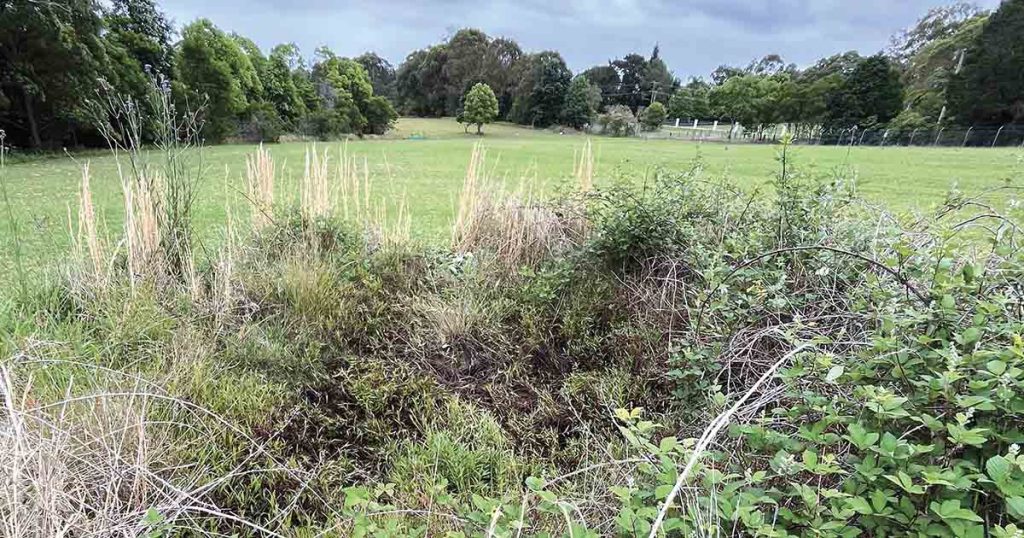
So, with documents and plans in hand, we approached the Fagan Park Supervisor and had an impromptu meeting to discuss and explore sites and are now confident to have located these areas of significance.
The Friends are currently in discussion with Council to preserve and maintain these sites and to have signage erected to tell the story of Sam Fagan’s Brick Kiln.
Don’t forget to visit Fagan Park on Australia Day, Monday 26th for our next Open Day.